Some families sit down to dinner and it looks effortless.
For others, the table can feel like one more place where things are hard.
If you are parenting a child with disability, you might be carrying the weight of therapies, appointments, school meetings, behaviour support plans, fatigue, financial pressure, uncertainty, and the quiet grief that comes and goes in waves. You might also be carrying something less visible.
The worry that your child is missing out on the everyday moments that build connection.
Not the big milestones. The small ones.
The simple moment of being asked a question, being given time to answer, and knowing that your voice matters here.
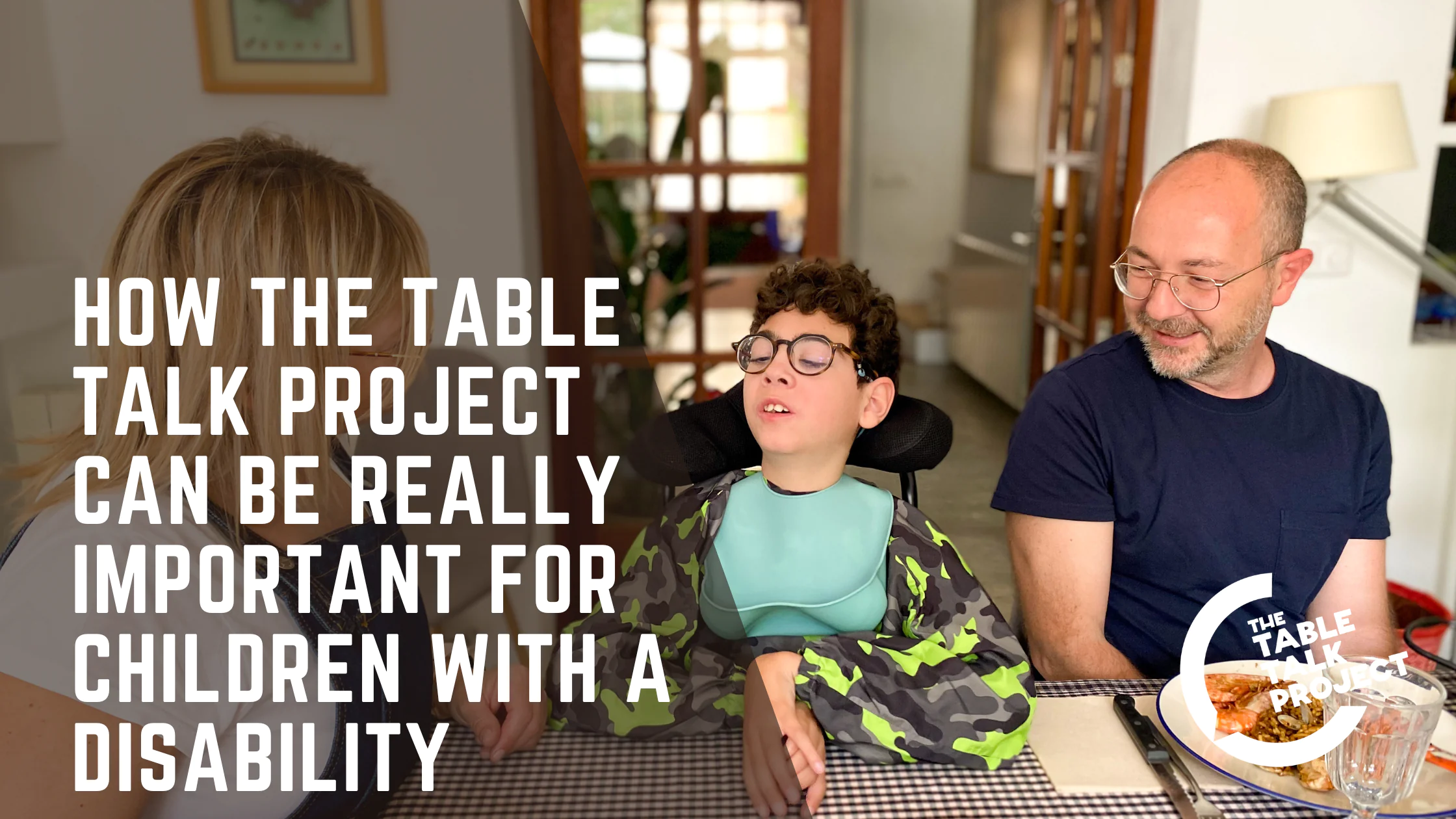
I know this personally. I am a dad to a son with a disability. And I have learnt that connection does not come from doing more. It comes from creating the right conditions, often in the most ordinary places, for everyone to belong.
That is why The Table Talk Project matters.
Not because dinner fixes everything.
But because it can become one of the most consistent, low pressure, repeatable opportunities in the week where your child is included, listened to, and known.
Why children with disability can be at greater risk of being unheard
Many children with disability experience barriers to communication and participation that other families rarely need to think about. This can include speech and language differences, sensory overwhelm, executive functioning challenges, fatigue, anxiety, social communication differences, or needing augmentative and alternative communication. When those barriers stack up, the message a child can absorb over time is painful.
It is easier for everyone if I stay quiet.
And that matters, because feeling heard and included is not a bonus. It is a protective factor for wellbeing.
Research consistently links family connection, supportive relationships, and a sense of belonging with better mental health outcomes for children and adolescents. For children with disability, those protective factors can be even more important because they may face higher rates of social exclusion, bullying, and loneliness.
When home becomes a place where they are consistently noticed and included, it helps buffer what they face outside the home.
The dinner table is not about food. It is about belonging.
When we talk about the dinner table, we are really talking about a routine. A predictable moment. A shared rhythm.
Routines matter for many children with disability because predictability can reduce anxiety and support regulation. When a child knows what is coming next, it frees up capacity to participate.
And while every family looks different, shared mealtimes are one of the most common routines available to families.
Research on family meals has found associations with improved family functioning, better communication, and protective effects for adolescent health and wellbeing. The relationship is complex and not every study shows the same strength of effect, but the consistent theme is this.
It is not the meal that matters most. It is the interaction.
It is the repeated experience of being together and being engaged with.
This aligns with broader family systems research which shows that warm, responsive family relationships support children’s social and emotional development.
For children with disability, that interaction often needs to be intentionally inclusive.
And that is where The Table Talk Project can help.
Why structured questions can reduce pressure and increase inclusion
A lot of family conversation fails for a simple reason. It relies on quick thinking and fast responses.
How was your day? What happened at school? Tell us something funny.
For a child with disability, especially where processing speed, language, recall, anxiety, or social communication are impacted, those open ended questions can feel like a test.
Structured conversation prompts help because they:
- give a clear starting point
- reduce cognitive load
- support turn taking
- reduce the pressure to perform
- allow different kinds of answers
The prompts in Back at the Table also help parents move from reporting questions to connecting questions.
Not what happened.
What mattered.
Not did you finish it.
How did that feel.
This is consistent with communication research suggesting that scaffolding and supportive conversation environments can improve participation and confidence, particularly for children who experience communication challenges.
It is also important for siblings
In families with disability, siblings can carry a lot too. Siblings of children with disability can face unique challenges. Sometimes they become little adults early. Sometimes they feel guilty for having needs. Sometimes they feel invisible because so much attention understandably goes to the child who needs extra support.
Inclusive table conversation gives siblings a structured way to share their world, not just make space for disability, but make space for everyone.
The goal is not equality in the sense of same time and same attention.
The goal is equity. Everybody gets what they need to be included.
The Table Talk Project is not about perfect dinners
Let’s say this clearly.
This is not another thing to do.
This is not a pressure filled vision of a calm table where everyone smiles and eats vegetables.
Many families parenting disability are surviving some days, and that is not a failure. It is reality.
The Table Talk Project is designed to work with real life. That means it works even if:
- your child only sits for five minutes
- someone is eating something different
- the table is noisy
- you need to move, fidget, stand, or take breaks
- you use pictures, devices, signing, or gestures
- you do it at breakfast instead of dinner
- you do it in the car
- you do it on the couch
Connection is not a place. It is a practice.
Practical ways to make table talk disability inclusive
If you are looking for broader supports, the NDIS has information for families and carers.Here are a few adjustments that many families find helpful. Take what fits and leave what does not.
1. Make participation flexible
Your child does not need to speak to participate. They can point, choose, gesture, type, show a picture, or answer with a scale. Augmentative and alternative communication is a valid voice.
2. Reduce sensory overload
Lighting, noise, seating, smells, and background clutter can be overwhelming. Small changes can increase tolerance and comfort.
3. Use shorter questions with choices
Instead of What was the best part of your day, try:
Which was better today, the start or the end
What felt hardest, morning or afternoon
Do you want a silly question or a calm question
4. Slow the pace down
Some kids need more processing time. Pause. Count to five in your head. Let silence do its work.
5. Celebrate small wins
If your child stayed for two minutes longer, that is something. If they smiled, looked up, or made a sound, that is something.
Progress often looks like tiny moments repeated.
What matters most for children with disability
Children with disability do not need a perfect table.
They need a safe one.
A place where they are not rushed. Not compared. Not corrected into compliance. Not spoken over. Not left out because it is easier.
They need what every child needs.
To be known. To be included. To be valued.
And they need families who are supported, not judged, as they try to create that.
If that is you, I want you to hear this.
You are not behind.
You are not failing because your table does not look like someone else’s table.
You are doing something courageous every time you keep showing up and try again.
The Table Talk Project exists because everybody deserves a voice at the table. That includes your child. And it includes you too.
If you want a gentle starting point
If you would like help putting this into practice at home, our 10 week program is designed to support families to build safer, more consistent connection.
Try this. Start with one question this week. One. That is enough.
Here is a simple one.
If you want a weekly prompt like this, you can subscribe to our newsletter.
When do you feel most understood, and what helps you feel that way?
And if your child cannot answer it yet, you can answer it first. You can model it. You can keep it short.
The goal is not a perfect conversation.
The goal is a repeated signal.
You belong here.
Partner with The Table Talk Project
