
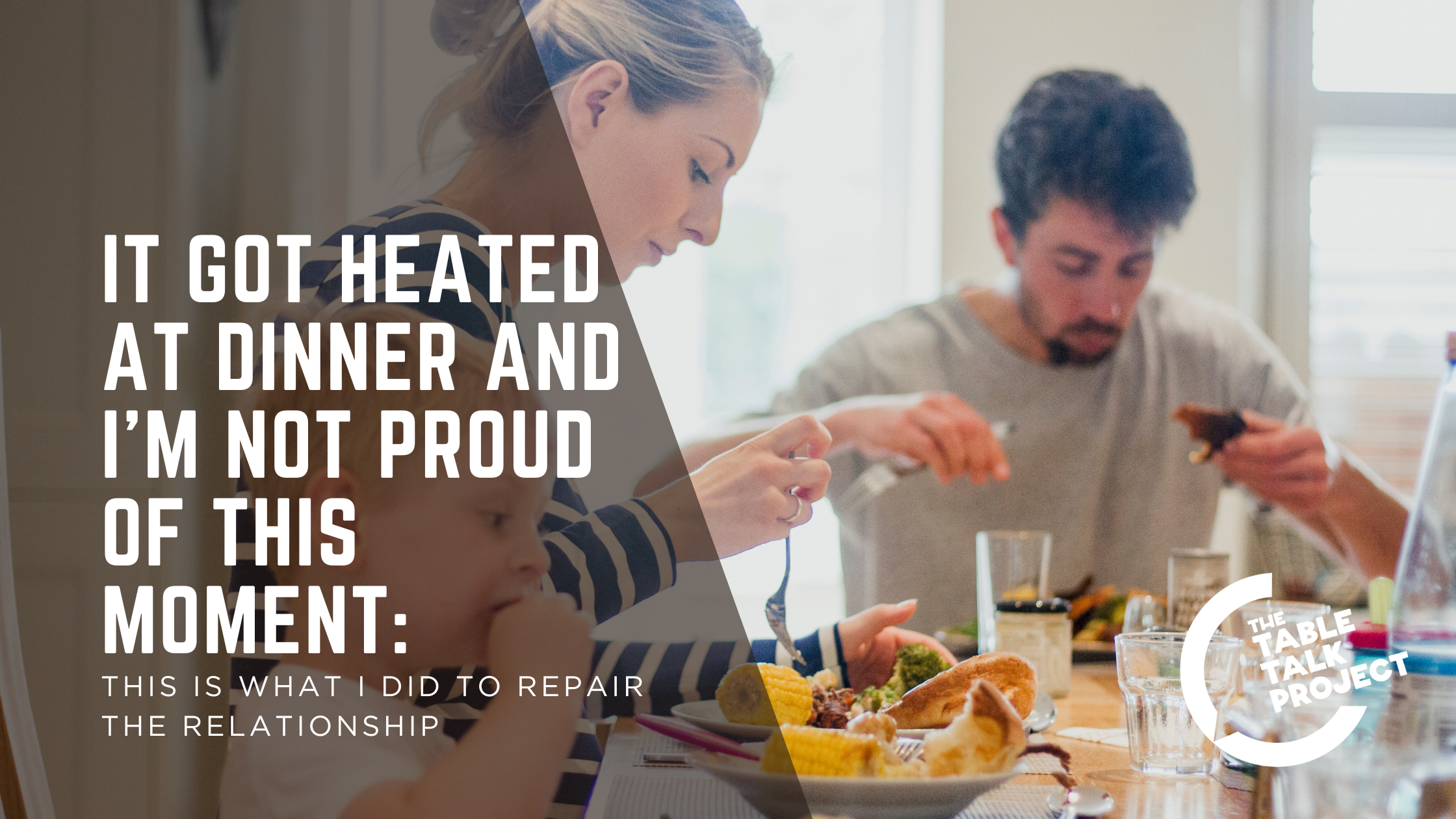
We only had one dinner together this week and it ended in some yelling, frustration and me leaving the room.
It had been a tense week with a lot going on and it felt like it all came to a head at the dinner table.
It started with me. It should have been a great time with great food and great conversation but it really wasn’t.
I brought my pain with me.
My son responded to that pain being shared in an aggressive way (not violent), just angry words.
My other family members just sat there shocked.
And afterwards, the embarrassment hit.
Not because there were fists or anything extreme, but because I know this truth: accusations, sharp words, and trying to control the conversation can do real damage too. Sometimes the loudest thing at the table is not the yelling. Sometimes it is the feeling that it is no longer safe to be yourself.
That is what I hate most about what happened. For a moment, our table did not feel like a safe place for everyone.
If you have had a dinner like this, I want to say something clearly: you are not alone, and you are not beyond repair.
Most families experience a moment like this at some point because parents are not robots. We bring our whole selves to the table. Our stress. Our grief. Our fatigue. Our fear. The build up from the day. The week. Sometimes the year.
This is not an excuse. It is a starting point.
Because one thing I have learnt from this moment is this: I was not aware of how much I was carrying as I went to sit down for dinner.
Are we ever. Do we ever take the time to consider it.
I certainly will be from now on.
Connection with our children often comes when we first connect with what is going on in us.
Connection with our children often comes when we first connect with what is going on in us.
Why this happens: the invisible load we carry to the table
Family dinner is meant to be a landing place. But it often becomes the first time we stop moving. The first time we sit still. The first time our nervous system gets a chance to catch up.
If your week has been heavy, dinner can become the point where the pressure releases.
Some parents have emotionally driven jobs, or just tough stuff happens that they carry. Sometimes our children trigger us and it tips us over the edge emotionally.
And when we are carrying a lot, we can misread normal behaviour as disrespect. We can feel challenged when no challenge was intended. We can hear a tone, an eye roll, a short answer, and suddenly our body reacts like we are under threat.
That is not weakness. That is being human.
But we still have responsibility for what we do next.
The moment after: what a rupture can teach us
I am terribly embarrassed by my behaviour. I wish I could rewind it. But I cannot.
What I can do is learn from it, and model what repair looks like.
Because the goal is not perfection. The goal is safety. The goal is a home where conflict does not equal disconnection.
The truth is, most families do not lose connection through one argument. We lose it through what happens after the argument.
Do we ignore it. Do we pretend it never happened. Do we blame the child. Do we carry the tension into the next day. Do we avoid the table for a week because it feels awkward.
Or do we repair.
Repair is how families become stronger.
Most families do not lose connection through one argument. We lose it through what happens after the argument.
Step 1: Pause and name what you are carrying
Before the next meal, take sixty seconds. Not a mindfulness performance. Not a perfect routine. Just a brief check in.
Ask yourself:
- What am I carrying into tonight’s meal
- What emotion is sitting closest to the surface
- What do I need to be able to show up as the parent I want to be
- What is one thing I can do in the next five minutes to lower my stress by ten per cent
That last question matters because we often aim for calm or control, and then we fail and feel worse. Ten per cent is realistic. Ten per cent is enough to change how you speak, how you listen, how you respond.
Try one of these small resets:
- Drink a glass of water before you sit down
- Step outside for two minutes and breathe slowly
- Put your phone away so your brain can stop splitting attention
- Name your feeling out loud to yourself: “I am carrying a lot today”
- Decide on a gentle intention: “I will be curious, not critical”
Step 2: If you have already ruptured, repair quickly and clearly
If dinner blew up, your next step is not to win the argument later. Your next step is to restore safety.
That begins with ownership.
Here is a simple repair script you can adapt. Keep it short. Keep it real. Keep it blame free.
- “I didn’t handle myself well at dinner.”
- “I brought my stress to the table and it came out as yelling and control.”
- “That is not the kind of home I want for you.”
- “I am sorry.”
- “You did not deserve that from me.”
- “Next time I will take a break before I react.”
- “If you are willing, I would like a fresh start.”
That last line is important. It invites reconnection without demanding it.
If your child responds with anger
Sometimes your apology will not be met with warmth. That is okay.
You can say:
- “I understand you are still upset.”
- “You do not need to forgive me quickly.”
- “My job is to keep repairing and keep making it safer.”
Step 3: Rebuild safety with boundaries that protect everyone
A safe table does not mean no conflict. It means conflict has limits.
A safe table does not mean no conflict. It means conflict has limits.
If yelling or aggressive words are part of what happened, you can set a boundary that protects everyone, including you.
Try this:
- “In our family, we can be angry, but we are not cruel.”
- “We can disagree, but we are not allowed to intimidate.”
- “If voices rise, we pause and take a break.”
- “We come back when we can speak with respect.”
Boundaries are not punishments. They are guardrails for connection.
Step 4: Replace control with curiosity
When we are stressed, we try to control the conversation. We correct. We lecture. We interrogate. We push for answers. We demand gratitude. We point out tone.
Curiosity does the opposite. Curiosity makes room.
Here are three curiosity questions that often soften the atmosphere:
- “What has been the hardest part of this week for you”
- “What do you wish I understood about how you are feeling lately”
- “What would help dinner feel easier tonight”
Curiosity does not remove parental leadership. It strengthens it. It says, “I can hold the room without overpowering it.”
Step 5: Create a simple reset ritual for future nights
You do not need a complicated family meeting. A consistent one minute ritual can change the tone.
Try this at the start of dinner:
The One Minute Reset
Each person answers one of these:
- One word for how I am arriving tonight
- One thing I need from the table tonight
- One thing I am grateful for today
This gives everyone a voice before the conversation drifts into correction, teasing, pressure, or silence.
It also helps you, as the parent, notice your own state before it becomes the loudest thing in the room.
When you are the one who brought the pain
This is the part I keep thinking about.
I brought my pain with me.
I did not mean to. But I did.
Many parents do. Especially parents who are carrying responsibility, emotional fatigue, financial pressure, grief, or unresolved experiences that get activated when a child pushes back.
If that is you, here is the truth that is hard to admit but freeing to accept:
Your children do not need you to be perfect. They need you to be accountable.
Accountability builds trust. Accountability rebuilds safety. Accountability teaches children how to own their mistakes too.
Your children do not need you to be perfect. They need you to be accountable.
And maybe, quietly, this becomes the legacy of the hard dinner.
Not that we never blow up.
But that we know how to come back.
A practical plan for your next dinner
If you want something simple to follow, here is your plan:
- Before dinner: ask yourself what you are carrying and lower it by ten per cent
- At the table: start with one minute of a shared reset question
- If tension rises: take a pause, name it, and suggest a break
- After dinner: repair fast, own your part, and apologise clearly
- This week: choose one small change that makes dinners easier, earlier meals, simpler food, fewer distractions, shorter dinners
Shorter dinners can still be meaningful. Ten good minutes is better than forty tense ones.
Conversation starter for tonight
If your family is ready for a gentle question that supports repair and safety, try this:
“What helps you feel safe to speak at our table, and what makes it harder?”
If that feels too direct, start here:
“When dinner is going well in our family, what is different?”
A final word, from one imperfect parent to another
I am still embarrassed about how I handled myself. I still wish it had gone differently.
But I am also grateful for what it reminded me.
We do not just bring food to the table.
We bring ourselves.
And if we want connection with our children, we often have to start by noticing what is going on in us first.
That is the work.
That is the invitation.
And that is how the table becomes a safe place again.
