
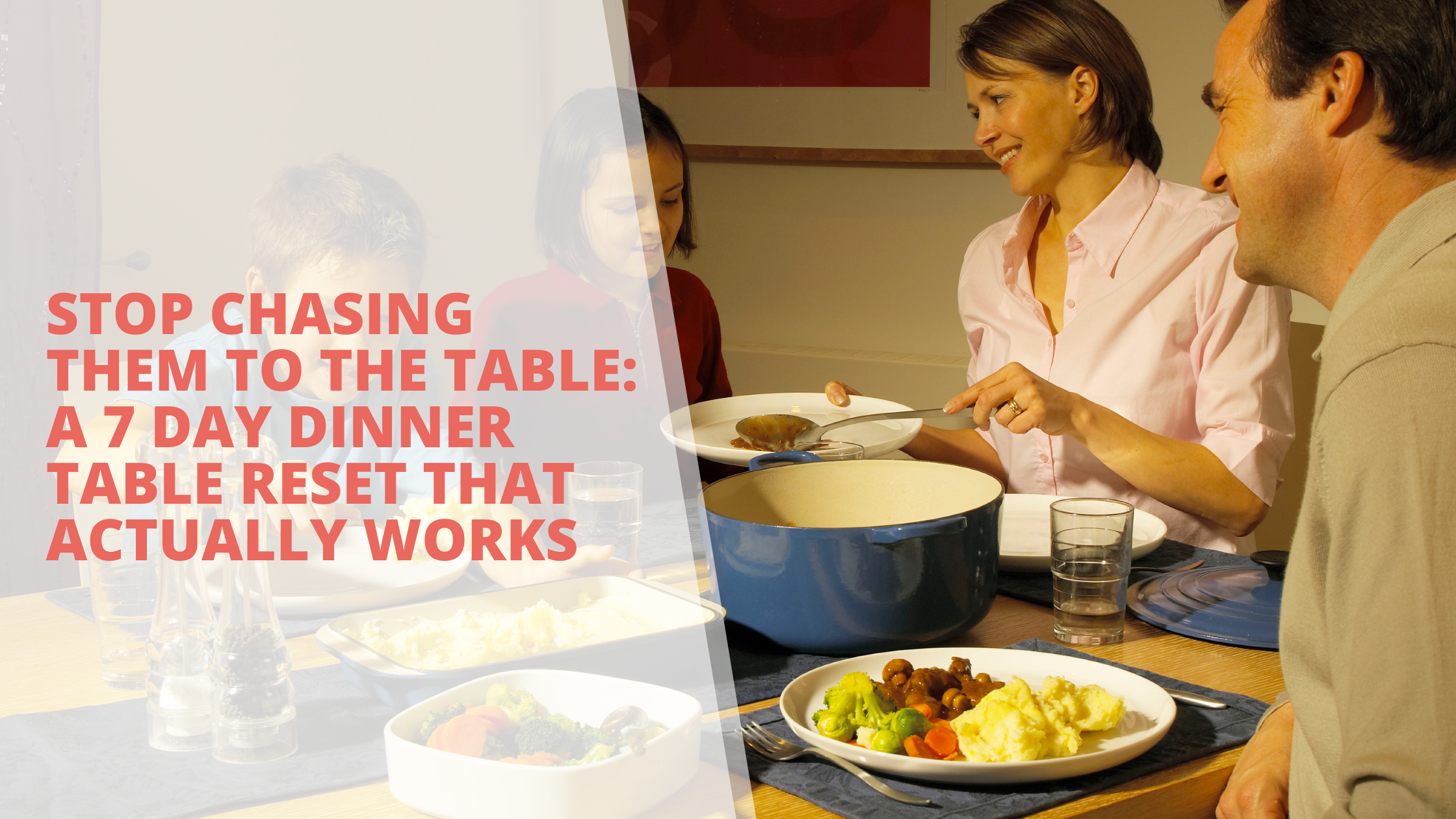
If you are honest, you are not just trying to get your kids to eat. You are trying to get them back.
Back to the room. Back to the family. Back to a place where you can see their face and hear what is going on inside them.
And for many parents, dinner has become the opposite of that. It is pressure. It is nagging. It is complaints. It is screens. It is someone storming off.
So let’s name the problem clearly.
Most kids do not refuse the table because they hate family. They refuse because dinner has become a place that costs them something. Attention. Freedom. Emotional safety. Energy. Control.
The goal is not to win dinner.
The goal is to rebuild the invitation.
Here is a seven day reset you can start tonight. It is designed for real families with real schedules. If you miss a day, keep going. This is not a program. It is a rhythm.
Because every child deserves a space where they have a voice at the table.
Day 1: Lower the bar so they can step over it
If dinner feels like a big demand, they will resist. Start small.
Your goal tonight is not a long sit down meal. Your goal is one moment of together.
Try one of these:
- Everyone sits for the first five minutes, then people can leave if they need to.
- A shared snack plate at the table.
- Breakfast at the table instead of dinner if evenings are chaos.
Say it out loud:
“Tonight we are keeping it simple. I just want to see you.”
Small wins build trust.
Day 2: Change the start, not the whole dinner
Most dinner battles begin in the transition. The switch from device to table, from bedroom to kitchen, from alone to together.
Fix the transition and you fix half the problem.
Try this:
- Ten minute warning.
- Two minute warning.
- Same phrase every night: “Two minutes, then we land at the table.”
Then give them an easy first step:
“Can you pour the water?” or “Can you grab the forks?”
Kids move more easily when their hands have a job.
Day 3: Remove screens with dignity
If you rip screens away, the table becomes the enemy.
If you build a norm, the table becomes predictable.
Try one of these:
- Devices charge in one spot during dinner.
- Everyone keeps phones off the table, including adults (other than the person using the Back at the Table Web App).
- If a teen is anxious, allow music before dinner, not during.
What matters most is this: do not make the rule the main event.
Make connection the main event.
A line you can use:
“We are not doing this to control you. We are doing this because you matter to us.”
Day 4: Give them power that helps the family
Kids cooperate more when they have ownership.
Not control over everything. Just a real role.
Choose one:
- They pick one meal a week.
- They choose the “dessert question” each night.
- They choose where they sit.
- They choose between two options: “Do you want to help cook or set the table?”
Ownership changes the story from “I have to” to “I’m part of this.”
Day 5: Make the table emotionally safer
Here is a hard truth.
Some kids avoid dinner because dinner is where they get corrected.
They walk into a room and brace for questions like:
“Did you do your homework?”
“Why are your grades slipping?”
“Do not talk like that.”
“What’s wrong with you today?”
Even when you mean well, it can feel like evaluation.
Tonight, protect the first five minutes.
No fixing.
No lecturing.
No performance review.
Start with one gentle question:
“What was the best part of your day?”
Or if they hate that, try:
“What was the hardest part?”
Then do something powerful. Reflect what you hear.
“That sounds annoying.”
“That must have felt awkward.”
“I get why you’d be tired.”
When kids feel safe, they stay longer.
Day 6: Learn repair, not perfection
Dinner will go wrong sometimes. Someone will snap. Someone will sulk. Someone will bait.
The goal is not a perfect table.
The goal is a repairable table.
If you lose your cool, say this:
“I did not handle that well. I’m sorry. I want this table to feel safe for you.”
If your child storms off, say this later:
“You are welcome back anytime. I’m here when you’re ready.”
This is how trust is rebuilt. Not through rules, but through repair.
Day 7: Create a simple ritual they can rely on
Children do not need a fancy dinner to feel connected.
They need something consistent.
Pick one ritual and keep it for a month:
- “High and low” around the table.
- A Friday night “takeaway at the table” night.
- Sunday dinner where everyone brings one question.
- Entree, Main, Dessert questions using The Table Talk Project rhythm.
Rituals turn dinner from an event into an anchor.
If you have a child who still refuses
Sometimes refusal is not stubbornness. It is stress, anxiety, sensory overload, sadness, friendship problems, or simply being depleted.
Treat consistent avoidance as information.
Try a gentle check in:
“I’ve noticed dinner feels hard lately. I care about you. What’s going on for you?”
And offer a smaller version:
“Can you sit with us for two minutes, then you can go?”
Two minutes becomes five. Five becomes ten. Ten becomes a habit.
Conversation starter for tonight
If you want one question that does not feel like a test, start here:
“When do you feel most heard in our family, and when do you feel least heard?”
Then listen. Do not defend. Do not explain. Just listen.
Because a child who feels heard is a child who comes back.
Final thought…
If dinner time has become tense, you do not need to throw the whole thing out. You need a reset that rebuilds safety and voice, one meal at a time.
That is why The Table Talk Project exists.
Choose one day from this reset and try it tonight. If you want more support, explore our conversation starters and tools to help your family build a rhythm where everybody has a voice at the table. there.