
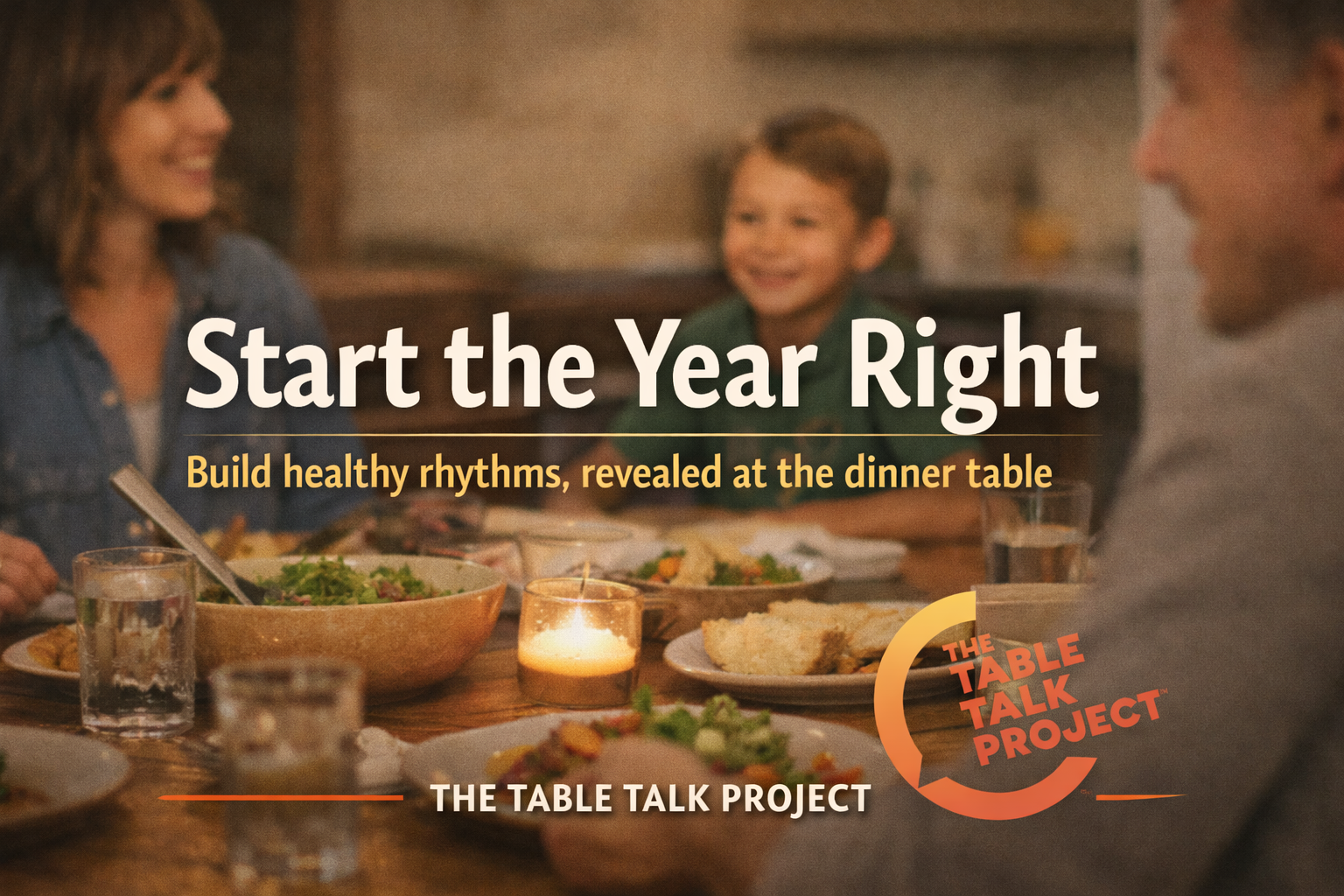
By the time February rolls around, most families are not failing because they are lazy. They are exhausted.
The school year restarts, work ramps up, sport calendars explode, and the mental load returns at full volume. That is why I do not love New Year’s resolutions. They often rely on motivation, and motivation is a terrible long term strategy.
What I do believe in is something quieter, kinder, and far more sustainable.
Healthy rhythms.
Rhythms are the small, repeatable patterns that make a home feel steady. They are not about perfection. They are about direction. And the best place to begin is often the simplest one.
The dinner table.
Why resolutions break, and rhythms work
Resolutions usually sound like this:
I will be more present.
We will eat healthier.
I will stop yelling.
We will have more family time.
They are good intentions, but they are often too big, too vague, and too dependent on an ideal week that does not exist.
Rhythms work because they are:
Small enough to repeat
Flexible enough to survive busy weeks
Built into real life, not a fantasy version of it
Focused on identity, not just outcomes
A rhythm is something you return to, even after you miss a day.
The Table Talk way to start the year
At The Table Talk Project, we believe everybody has a voice at the table.
So rather than setting a family resolution like, “We will be a better family this year,” we help families practise one rhythm:
We sit. We share. We listen.
That is it. That is the starting point.
When a family has a rhythm of connection, everything else becomes easier to navigate, including stress, behaviour, conflict, and change.
A simple framework: The Three Rhythms
If you want to start the year right, choose rhythms in three areas.
1. Rhythm of presence
Pick one moment in your day where you are fully there.
Not all day. Not every hour. Just one moment.
Try this:
Three dinners a week where phones are not at the table.
If three feels too hard, start with one.
2. Rhythm of conversation
Connection grows through small, consistent questions.
Try this:
One conversation starter at dinner, even if it is just five minutes.
If your children are young, keep it simple.
If your children are teens, keep it real.
If your children are adults, keep it respectful and curious.
3. Rhythm of repair
Every family has moments they wish they could redo. The difference is whether repair is normal.
Try this:
A weekly check in question: “Was there a moment this week where I did not show up how you needed?”
You are not asking to be criticised. You are modelling humility and trust.
Your first week: a realistic plan that works in real homes
Here is a rhythm you can try this week before the year gets away from us. It is simple, and it is designed for families who are busy.
The One Table Rhythm
Choose one night this week and do these three things:
Sit together for ten minutes
Ask one question
End with one sentence of appreciation
That is all.
Conversation starter for the week
“What is one thing you want more of this year, and one thing you want less of, and how can we help?”
If you have little ones, you can simplify it:
“What do you want more of this year?”
If you have teens:
“What do you want this year to feel like?”
If you have adult kids:
“What would make this year feel like a good year for you?”
What if we miss it?
You will.
Someone will be late. Someone will have sport. Someone will be tired. Someone will be grumpy. Someone will not talk.
That is normal.
Rhythms are not brittle. They bend and return.
Instead of giving up, say this sentence out loud:
“We are a family that comes back to the table.”
That is the rhythm.
Make it easier: set up your environment
If you want rhythms to stick, design for success.
Try one of these:
Put a bowl or basket near the table for phones
Leave conversation starter cards on the table where everyone can see them
Pick the same nights each week so you do not have to decide every day
Keep dinner simple for the first month, because connection matters more than complexity
You are not building a perfect routine. You are building a reliable one.
A gentle reminder for parents
Starting the year right is not about doing more. It is about doing what matters, more consistently.
Your children do not need a high performing parent.
They need a steady one.
A parent who returns.
A parent who listens.
A parent who makes space for their voice.
That is what healthy rhythms look like in a family.
Try this tonight
If you do nothing else, do this.
At dinner, ask:
“What was the best part of your day, and what was the hardest part?”
Then listen without fixing.
That alone can shift the tone of a whole week.
Call to action
If you want help building sustainable family rhythms, The Table Talk Project is here for you.
Start with one conversation this week.
Choose one night.
Ask one question.
Make space for every voice.
And if you want more structured support, our resources and programs are designed to help families build connection that lasts well beyond January.
