
The other day at my son’s footy training I was chatting with one of the dads while the boys were out on the field. We started talking about work and what each of us does. He shared about his trade, and I told him about The Table Talk Project and how we help families have meaningful conversations around the dinner table.
His response was one I hear often.
He said, “I reckon it’s been over a year since we ate together as a family all together. Normally I end up eating by myself, my son in his room, and my wife and daughter watching MAFS or something in the lounge.”
Sadly, that kind of story is not unusual.
For many families, shared meals are no longer a regular rhythm. Life is busy. People are tired. Work runs late. Devices fill the gaps. Everyone is in the same house, but not always together.
Then he said something else. Something I have not stopped thinking about since.
He asked, “Have you got any questions I can talk to my kids other than ‘how was your day?’ Because I just get ‘good’, ‘bad’, ‘it was terrible’, that sort of thing.”
I said, “What you are talking about is the difference between open and closed questions.”
And he replied, “What is that?”
That moment stayed with me.
Because it made me realise something important.
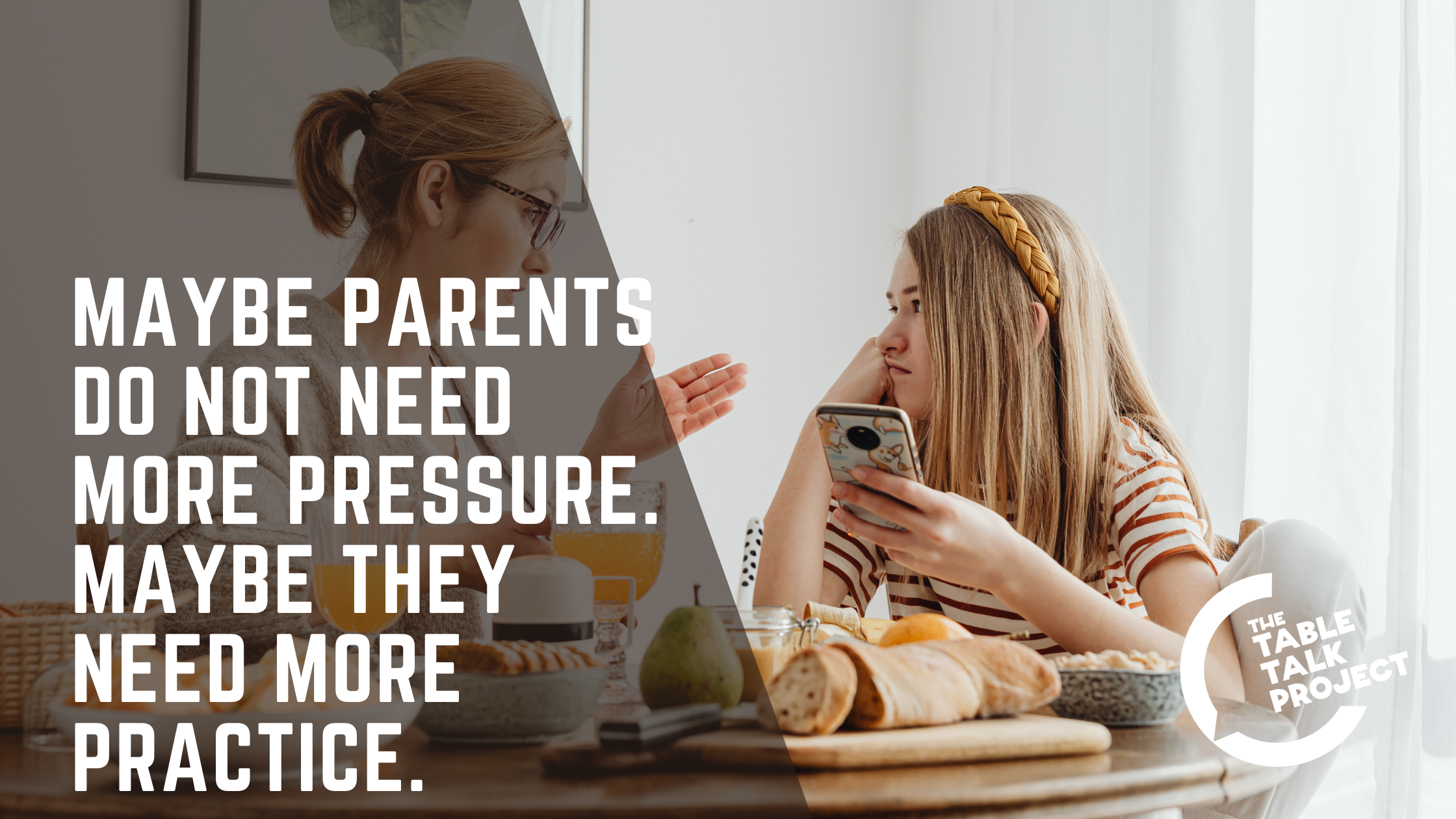
Maybe many mums and dads are not resisting meaningful conversations. Maybe they have just never been taught how to have them.
We assume parents know how to connect
There is so much pressure on parents.
Be present.
Be calm.
Be intentional.
Switch off devices.
Eat together more.
Talk deeply.
Build trust.
Create connection.
But what if no one has ever shown you what that actually looks like?
What if you grew up in a home where conversation was mostly about logistics, correction, or silence?
What if nobody modelled curiosity, warmth, listening, or emotional safety?
What if the only question you know to ask is, “How was your day?”
We can tell parents that meaningful conversations matter, and they do. But if parents have never learned the basics of communication, then the advice can feel out of reach.
Not because they do not care.
Because they do not yet have the tools.
That is not failure. That is a gap we can help fill.
A meaningful conversation is not about being deep all the time
When people hear the phrase “meaningful conversation”, they can sometimes imagine something intense or serious. But most of the time, meaningful conversation is much simpler than that.
It is a conversation where someone feels noticed.
It is a moment where a child feels listened to.
It is an exchange that goes beyond surface-level reporting.
It is not perfect. It is just real.
Meaningful conversations are often built through small moments, not big speeches.
They grow when parents learn how to ask better questions, slow down their reactions, and stay interested a little longer. Every conversation matters.
Why “How was your day?” often does not work
There is nothing wrong with asking, “How was your day?”
The problem is that it usually invites a very short answer.
“Good.”
“Fine.”
“Bad.”
“Boring.”
That is because it is often a closed question.
A closed question can usually be answered with one word or a small amount of information.
Open questions are different. They invite reflection, story, emotion, or detail.
That does not mean every question has to be clever. It just means it needs to open a door rather than close one.
For example:
Closed question: Did you have a good day?
Open question: What was one part of your day that stood out?
Closed question: Did school go okay?
Open question: What felt easy today, and what felt hard?
Closed question: Are you alright?
Open question: What has been on your mind today?
Sometimes just changing the wording is enough to completely shift the conversation.
If meaningful conversation was never modelled, start here
If this does not come naturally to you, you are not alone. And you are not behind.
You do not need to suddenly become a communication expert. You just need a few simple starting points that help your child feel safe, seen, and worth listening to.
Here are some practical ways to begin.
1. Replace pressure with curiosity
Parents often feel pressure to “get a good conversation going”. Children can feel that pressure too.
Instead of trying to force depth, aim for curiosity.
Try saying things like:
“I’d love to know more about that.”
“What was that like for you?”
“Tell me more.”
“What do you mean by that?”
“What happened next?”
These are simple prompts, but they communicate something powerful.
I’m interested in you.
I’m not rushing you.
You matter.
2. Ask one better question, not ten
Sometimes parents ask too many questions in a row because they are trying hard to connect.
That can start to feel like an interview.
Instead, choose one thoughtful question and give it room.
You could ask:
What made you laugh today?
What drained you today?
Who did you enjoy being around today?
What is something you wish went differently?
What is one thing you are looking forward to tomorrow?
One better question is often more effective than ten rushed ones.
3. Learn the power of follow-up questions
The first answer is not always the full answer.
If your child says, “School was annoying,” there is a temptation to jump straight into fixing, correcting, or moving on.
Instead, try a gentle follow-up.
“What made it annoying?”
“Was it a person, a moment, or just the whole day?”
“What do you wish happened instead?”
Follow-up questions tell your child you are actually listening, not just waiting for your turn to speak.
4. Do not panic if your child gives short answers
Some children are naturally talkative. Others are not.
Some open up quickly. Others take time.
A short answer does not always mean rejection. Sometimes it just means your child is tired, unsure, distracted, or not yet ready.
Stay calm. Stay kind. Stay consistent.
Connection is often built through repeated safe moments, not one perfect dinner conversation.
5. Share something of yourself too
Meaningful conversation should not feel like a spotlight only on your child.
Sometimes children open up more when parents go first in a simple and age-appropriate way.
You might say:
“One thing I found hard today was…”
“I had a moment today that made me really grateful…”
“I got frustrated today, but I handled it better than I might have in the past…”
This models honesty without oversharing. It also shows your child that reflection is normal.
6. Create questions that are easy to answer
Some parents accidentally ask questions that are too broad.
“What is going on in your life at the moment?” can feel too big.
Instead, make questions specific and doable.
Try:
What was the best part of lunch today?
Who did you spend the most time with today?
What was something you noticed about someone else today?
What felt unfair today?
What was one win, even a small one?
Specific questions are often easier for children and teenagers to enter into.
7. Make the goal connection, not control
Sometimes parents ask questions because they want information, compliance, or reassurance.
Children can usually feel that.
Meaningful conversations grow best when the goal is connection first.
That does not mean there is no place for guidance, boundaries, or correction. Of course there is. But if every conversation feels like a check-up, children may stop offering much at all.
Try to let some conversations simply be about knowing your child better.
8. Start small if your family is out of rhythm
If your family has not eaten together in a long time, do not aim for a perfect seven-night dinner routine straight away.
Start with one shared meal a week.
Or one shared snack.
Or one screen-free conversation in the car.
Or ten minutes around takeaway on a Thursday night.
The goal is not performance. The goal is practice.
Connection usually grows through rhythms that are realistic enough to repeat.
9. Use conversation prompts when words do not come easily
Some families need a little help getting started, and that is okay.
Prompts can reduce the pressure because they give everyone something to respond to.
A few simple ones could be:
When do you feel most listened to in our family?
What is something you wish adults understood better about kids?
What is one thing that made you feel proud this week?
What helps you feel better when you have had a hard day?
What is something fun we should do together soon?
Sometimes a good question can do what good intentions alone cannot.
10. Remember that skill can be learned
This may be the most important point of all.
Communication is not just personality. It is a skill.
That means parents can learn it.
Children can learn it.
Families can practise it.
Homes can change.
You do not have to stay stuck with the same shallow patterns you have always had.
You do not need to be brilliant with words.
You just need to be willing to begin.
Maybe this is where we need to start
That conversation at footy training has stayed with me because it highlighted something we do not talk about enough.
If we want families to have meaningful conversations, we cannot just tell them to do it. We need to show them how.
We need to help parents understand the basics.
What a good question sounds like.
How to listen without rushing.
How to follow up.
How to stay present.
How to create safety.
How to make room for every voice at the table.
Because for many parents, this was never modelled.
And if it was never modelled, then shame will not help. Practical support will.
That is part of what continues to drive The Table Talk Project.
Not just encouraging families to gather, but helping them know what to do when they get there.
A simple place to start tonight
At your next meal, or in the car, or before bed, try asking just one of these:
What was one moment today that stuck with you?
What is something that felt harder than it should have today?
Who made your day better today?
What is something you wish I asked you about more often?
What is one thing you would love our family to do better?
Then pause. Listen. Do not rush to fix.
Just begin there.
Because sometimes one better question can open the door to a better relationship.
