
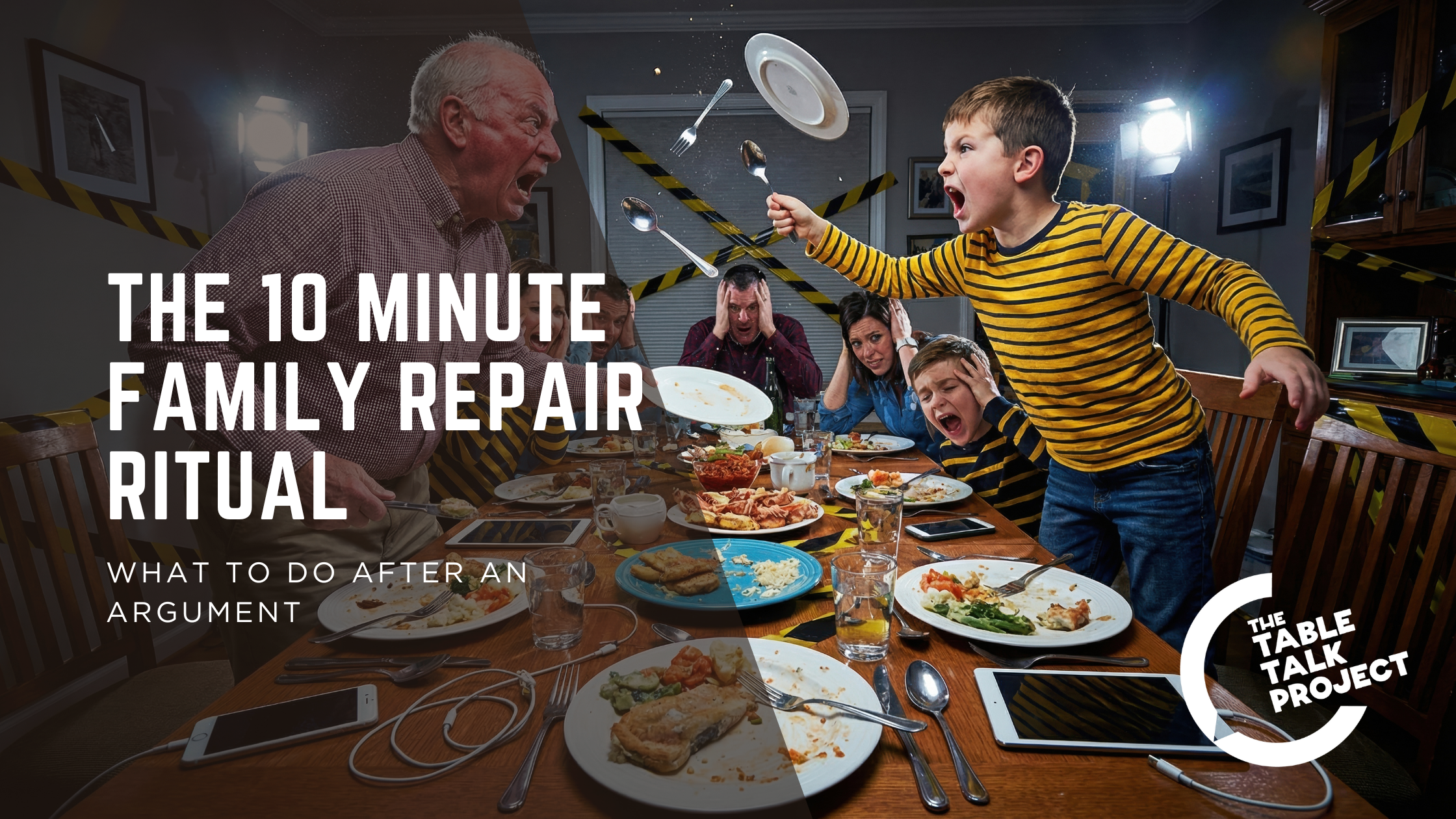
Every family argues. Siblings snap, parents get short, someone storms off, everyone feels tense, and then the house goes quiet. The awkward part is what happens next.
Most of us were never taught how to repair. We were taught to avoid, to move on quickly, or to “say sorry” without really rebuilding trust.
Today’s blog is about a simple, evidence-informed repair ritual you can use after conflict. It does not require a perfect apology. It does not require a big conversation. It just creates a predictable path back to connection, so everybody has a voice at the table.
The moment after conflict is the moment that matters
Conflict itself is not the enemy. Families can disagree and still be deeply connected.
What breaks trust is when conflict is followed by silence, shame, or ongoing bitterness. Kids and teens often learn one of two unhelpful lessons:
- My feelings are too big for this family
- If I mess up, connection is removed
Repair teaches a different lesson:
We can have hard moments and still belong.
That sense of belonging is the foundation of emotional safety at home. It helps children and young people take responsibility, speak honestly, and stay connected, even when things are messy.
Why “just say sorry” often does not work
A forced apology can feel like a performance. It can also skip the most important part of repair, which is understanding and reassurance.
Real repair is usually made up of three ingredients:
- Owning what happened, without excuses
- Naming the impact, how it landed for the other person
- Reconnecting, a small action that restores closeness
When families practise repair consistently, conflict becomes less scary. People recover faster. And the home becomes a place where you can tell the truth and still be loved.
The 10 Minute Family Repair Ritual
This is designed to be short, repeatable, and doable. You can use it between a parent and child, between siblings, or as a whole family moment after a blow-up.
You are not trying to solve everything. You are simply reopening connection.
Step 1: Regulate first (2 minutes)
Before you talk, help bodies calm down.
Try one of these:
- A glass of water and three slow breaths
- A short walk to the letterbox
- Two minutes of quiet in separate rooms, then regroup
If you try to repair while everyone is still flooded, the conversation will become a second argument.
A helpful line is:
“I want to fix this with you, I just need two minutes to calm my body first.”
Step 2: Name the moment (1 minute)
Keep it simple. No speeches.
- “That got heated.”
- “We had a rough moment.”
- “I did not like how that went.”
This matters because it brings the conflict into the light without blaming anyone.
Step 3: Own your part (2 minutes)
Each person answers one sentence:
“What I wish I did differently was…”
Examples:
- “What I wish I did differently was speak with respect.”
- “What I wish I did differently was not slam the door.”
- “What I wish I did differently was listen before I reacted.”
If your child is young, you can model first and keep their version short.
If your child is a teen and refuses, you can still model ownership yourself. One sincere adult repair can soften a hard room.
Step 4: Name the impact (2 minutes)
This is where empathy grows. Ask:
“How do you think that felt for them?”
Or speak it directly:
“When I raised my voice, I imagine it felt scary and unfair.”
For siblings:
“When you grabbed that off them, I imagine it felt disrespectful.”
You are not agreeing with everything. You are acknowledging how it landed.
Step 5: Reconnect with one small action (3 minutes)
Repair is not just words. It is a movement back towards each other.
Choose one:
- A quick hug, high-five, or fist bump
- Making a cup of tea together
- Sitting at the table for two minutes and asking one gentle question
- Writing a note if talking is too hard
Then finish with a clear statement of belonging:
“I love you. We are ok. We will keep practising.”
What if someone refuses to repair?
That happens. Especially with teens, and especially when shame is high.
Try these approaches:
Keep the door open
“I am ready to repair when you are. You matter to me.”
Offer a lower-pressure option
“Do you want to talk, text, or just sit with me while we do something else?”
Repair unilaterally
You can name your part and reassure connection even if the other person is not ready to engage. This shows maturity and safety.
“I am sorry for my tone. You did not deserve that. I am here when you are ready.”
Make repair a family culture, not a one-off
Like any skill, repair becomes easier when it is normal.
A simple way to build this into family life is to introduce a shared language. For example:
“In our family, we do repair.”
You can even create a small routine at the dinner table once a week:
- One thing I handled well this week
- One thing I want to do better next time
- One way I can make it right if I have hurt someone
This is not about guilt. It is about growth and belonging.
How The Table Talk Project can help
Repair is much easier when you have prompts that guide you, especially when emotions are high.
Our Back at the Table tool is designed to make meaningful conversation feel doable, not daunting. It gives families simple questions that help everyone speak, listen, and reconnect, one small moment at a time.
If your family has had a tough week, start small. One question. One course. One two-minute reconnection. Consistency matters more than perfection.
Conversation starter for your table
When we have a disagreement, what helps you feel safe again, and what makes it harder?
If you want to go deeper, add:
What does a good apology look like to you?
Call to action
Tonight, do not aim for a perfect family dinner. Aim for one repair moment.
Choose a time when things are calm, sit together for 10 minutes, and try the Family Repair Ritual. Then use one conversation starter to help everyone feel heard.
If you would like support, explore the Back at the Table tool and start building a culture where everyone has a voice at the table.
